
I didn’t plan to spend March in Switzerland. Nobody plans to spend March in Switzerland unless they’re in private banking or running from something.
I was running from an airspace closure.
One week you’re running university partnerships in Dubai, the next you’re at a café in Lausanne watching the Alps through the window, answering video calls that would have been in-person coffees.
That’s the thing nobody puts in the risk register when building across regions: you can’t hedge against geopolitics, and you definitely can’t hedge against whatever Trump decides to do on a Tuesday.
So. Switzerland.
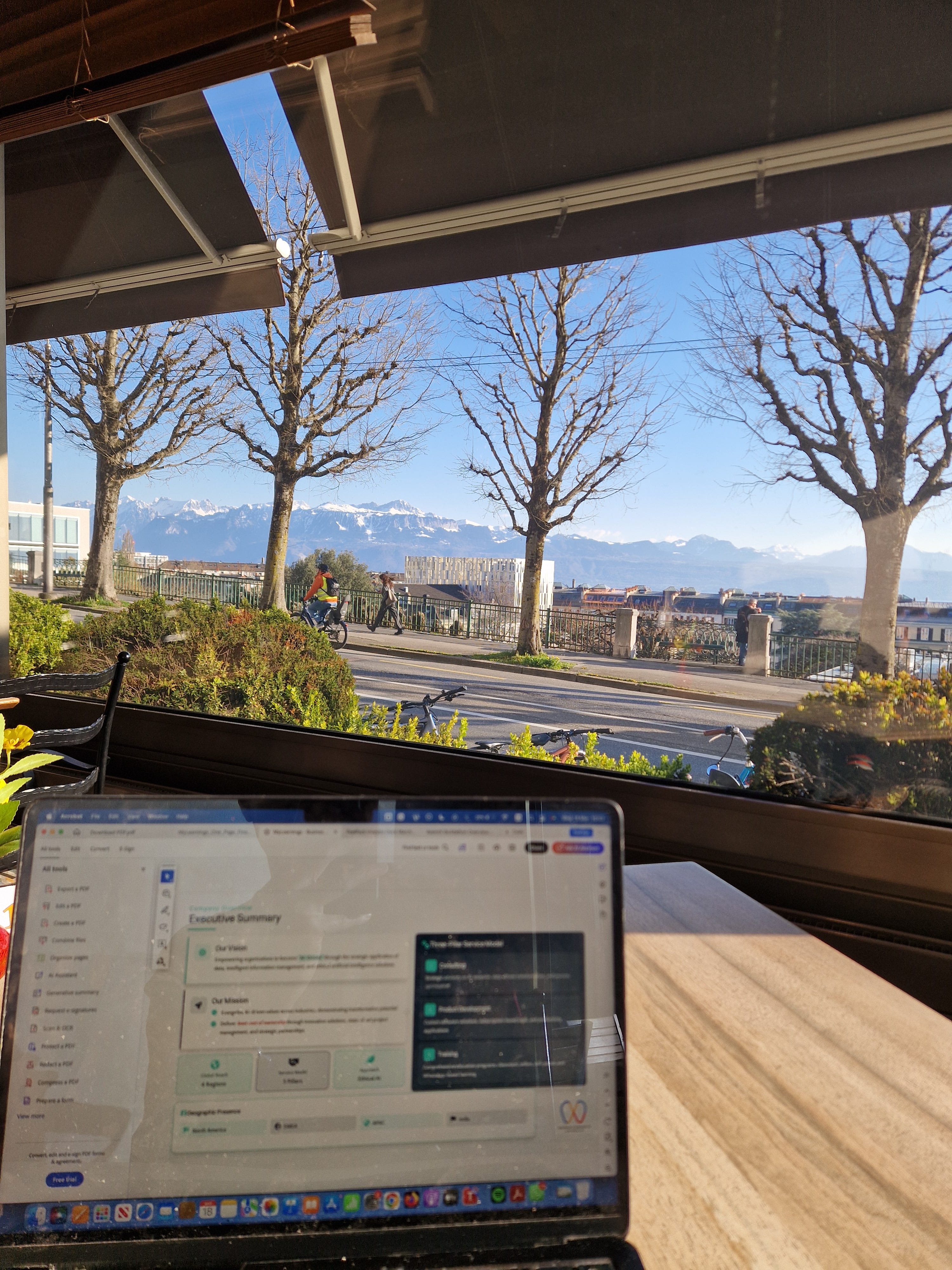
The office this week
One of the densest concentrations of intelligence in Europe
While I was here I met the head of the EPFL Innovation Park for coffee. We talked for an hour about spin-offs, pipelines, and where the talent was going. The person at the table next to us was either working on something that will matter in a decade, or having a very heated call with their co-founder in a language I couldn’t identify. Possibly both.
The work coming out of this place is genuinely staggering.
EPFL is top five globally in engineering.
Over 500 spin-offs since 2000.
One of the highest concentrations of PhDs per square kilometre anywhere in the world.
And yet, when you look at what that talent produces commercially, the gap between the science and the scale is striking.
The easy explanation is capital. Not enough local VCs, not enough risk appetite, not enough of the infrastructure that turns research into revenue. True, and it matters. But I don’t think it’s the core of it.
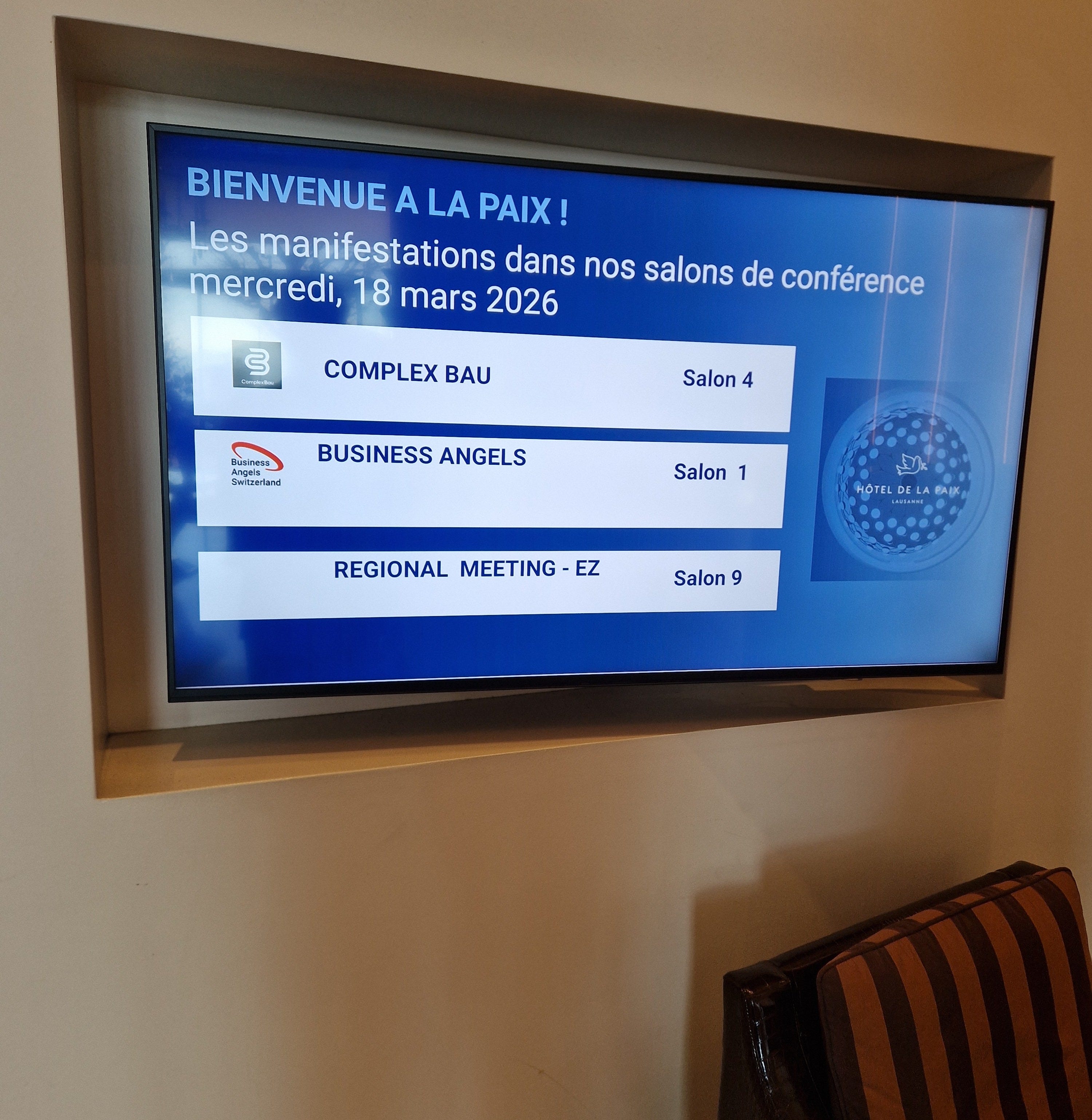
My hotel having a Business Angels meeting down the hall. The universe has a sense of humour
Excellence and stability don’t create urgency
The harder explanation: Lausanne optimises for excellence and stability. Both genuine virtues. And both of which quietly work against the specific kind of hunger that builds global companies.
This is a city where a brilliant postdoc can live extraordinarily well. The lake, the mountains, the salary, the institutional prestige. The €16 pint, which after 5 years in Paris I still cannot process emotionally.
The environment tells talented people: you have already arrived.
And when you have already arrived, the burning need to build something from nothing, to take the risk, to move to a market you don’t understand yet, becomes very hard to justify.
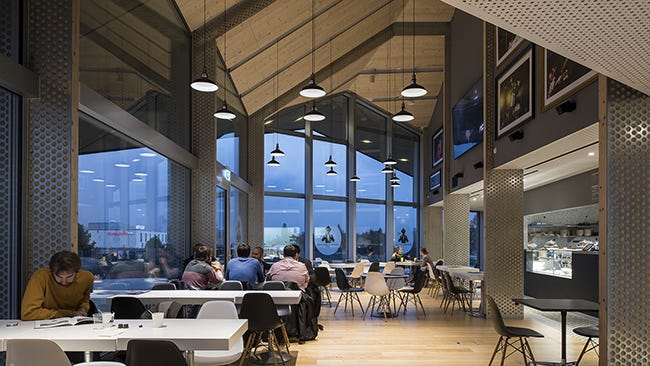
The EPFL cafeteria. Atleast 5 people in this pic are definitely smarter than me (probs all 7)
Compare that to the founders who do break out.
Nexthink, the EPFL spin-off that became a unicorn, relocated its co-founder to Boston. MindMaze, Lausanne’s neurotech success story, built its commercial operations far from where the science was done. The pattern repeats: the research stays, the ambition leaves.
A different kind of environment
Which brings me to the part nobody in Lausanne is really talking about: the Gulf.
The GCC is actively looking for exactly what EPFL produces. Deep tech in climate, energy, built environment, healthcare. Governments with capital, a mandate to diversify, and a genuine appetite for frontier technology. And an almost total absence of the kind of institutional familiarity that would make a Lausanne founder think: that’s a market worth understanding.
The distance from EPFL to Abu Dhabi is six hours. The distance in mental model is much larger.
Closing that gap is what brought me to the Gulf in the first place. It’s also what keeps bringing me back to Europe.
Lausanne doesn’t have a talent problem. It doesn’t even really have a capital problem, though more would help. It has a geography-of-ambition problem. The best founders here aren’t thinking small. They’re just not yet thinking Gulf.
That’s a solvable problem. And it starts with someone making the case clearly enough that the next generation of EPFL postdocs adds Abu Dhabi to the list alongside Boston, Zurich, and London.

Spotted in Lausanne on my last night. Felt like a sign
More from the European road soon. Next stop: Milan.
If you want the next dispatch before it hits LinkedIn, subscribe below.