
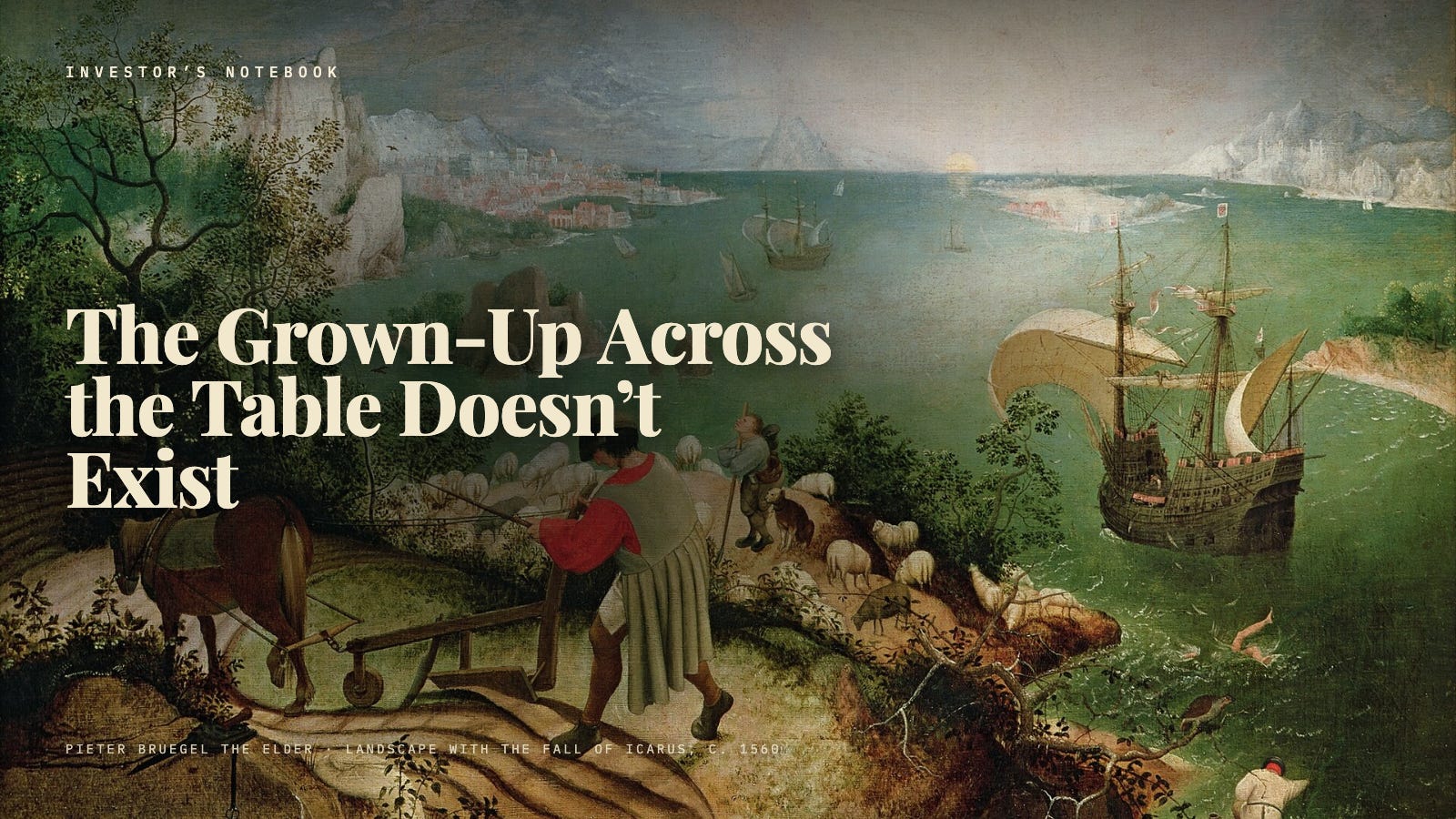
In the 1980s, a Japanese psychiatrist named Hiroaki Ota described a curious phenomenon. Japanese tourists would arrive in Paris after years of imagining the City of Light: romantic cafés, elegant boulevards, perfect manners. Instead they found rude waiters, graffiti, traffic, and ordinary people living ordinary lives. For a few of them, the gap between the city they’d pictured and the one in front of them was genuinely destabilising.
They called it Paris Syndrome.
I funded companies from Paris for five years, and the most damaging version of Paris Syndrome I ever saw had nothing to do with the city.
It happened to founders, not when they visited Paris, but when they walked into a VC meeting.
The grown-up you’ve invented
Long before the meeting, they’ve built an image in their head. The investor is smarter. More experienced. More certain. Someone who sees around corners, who can look at a business for thirty minutes and know whether it’ll be worth a billion dollars. Someone who already has the answer.
Then they spend enough time around investors and discover something unsettling.
The grown-up across the table doesn’t exist.
Not because investors aren’t intelligent. Some of the smartest people I’ve ever met work in venture capital. But intelligence and certainty are not the same thing.
The people who passed on Google
In 1999, a partner at Bessemer, one of the most respected firms in the world, was offered an introduction to two Stanford students with a new kind of search engine. He asked how he could leave the house without going anywhere near their garage.
The students were Larry Page and Sergey Brin.
And it wasn’t a one-off. Bessemer still keeps a public anti-portfolio of the companies it passed on, including Apple and FedEx. Airbnb was rejected by respected investors who couldn’t imagine strangers sleeping in each other’s homes.
Brilliant people looked at the same facts and reached different conclusions. The mythology is that great investors always know.
The reality is that great investors get comfortable deciding while not knowing.
Inside investment committees, the biggest surprise was never how often investors were right.
It was how often they disagreed with each other.
Your own Paris Syndrome
You spend three weeks perfecting your pitch. The partner answers email halfway through your presentation.
You leave convinced you’ve destroyed the meeting.
Two months later, they ask for another.
The investor who told you your market was too small leads your competitor’s round six months on.
You imagine you’re walking into an exam, as though the investor holds the correct answer and is waiting to see if you do too. But there’s no answer sheet. There are only people trying to make a good decision with incomplete information: the investor, the founder, the market, everyone.
Where it stops rhyming with Paris
And here is where it stops rhyming with Paris. Paris Syndrome is a disease: the gap between fantasy and reality is what breaks the tourist. This one is the opposite. The gap is the cure. You just mistake it for the wound. The day the grown-up across the table disappears is the day you can stop auditioning for them.
The experienced operator is the one most likely to miss this, and it’s almost touching why.
You’ve spent twenty or thirty years being genuinely good at a hard thing, so when you step into a room where you’re a beginner, you extend the people who live there the competence you’ve earned everywhere else.
You hand them an authority they don’t have. And the moment you’re seeking permission, everything formidable about you turns against you: you under-explain, you defer; you answer the question they asked instead of the one that would have shown them what you are.
You let them interrogate the business instead of translating it for them.
What they’re actually deciding
Eventually you realise something strange.
The investor isn’t trying to work out whether your company is good.
They’re trying to work out whether they can explain it to the rest of their partnership on Monday morning.
Those aren’t the same thing.
The first you can’t control.
The second is your job.
If you’ve built something real but still walk into meetings waiting to be judged by an authority you invented, you’ve misunderstood the room.
There isn’t a grown-up across the table.
There are only two people trying to understand the future before anyone else does.
Your job isn’t to convince the investor you’re right.
It’s to help them see what you’ve already seen.
Worth keeping
Investor and mathematician Jim Simons, on beauty:
“Be guided by beauty. I think pretty much everything I’ve done has had an aesthetic component, at least to me. Now, you might think, ‘Building a company that’s trading bonds? What’s so aesthetic about that?’ What’s aesthetic about it is doing it right. Getting the right kind of people, and approaching the problem, and doing it right. And if you feel that you’re the first one to do it right, that’s a terrific feeling. It’s a beautiful thing to do something right.”
My read, from the other side of the table: he isn’t describing certainty. He’s describing the feeling of having done something right. That’s the one thing an investor can’t manufacture for themselves, so they borrow conviction from the founder who clearly has.
One question before you go
Think about the last investor meeting you can’t stop replaying.
When that person walked back to their partners, could they have explained your company without you in the room?
Or did you leave it to chance?
Hit reply and tell me the meeting. I read every one.
Until next time,
Rohan
Former VC.
Helping founders become fundable.
And if this would land for a founder dreading a room right now, forward it to them.
Clipped
Ever wondered what a guy take on robots on FrenchTV looked liked? I got you covered.
Worth wheeling this guy out for every new generation of robots to benchmark.